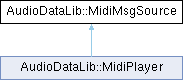
Instances of this class represent any source of MIDI messages. More...
#include <MidiMsgSource.h>
Public Member Functions | |
| MidiMsgSource () | |
| virtual | ~MidiMsgSource () |
| virtual bool | Setup (Error &error) |
| virtual bool | Shutdown (Error &error) |
| virtual bool | Process (Error &error) |
| void | AddDestination (std::shared_ptr< MidiMsgDestination > destination) |
| void | Clear () |
| template<typename T > | |
| T * | FindDestination () |
Protected Member Functions | |
| bool | BroadcastMidiMessage (double deltaTimeSeconds, const uint8_t *messageBuffer, uint64_t messageBufferSize, Error &error) |
Protected Attributes | |
| std::vector< std::shared_ptr< MidiMsgDestination > > * | destinationArray |
Detailed Description
Instances of this class represent any source of MIDI messages.
The user might provide a derivative of this class, for example, that can receive messages from a MIDI port. One is not provided by this library, because one of the goals of this library is to depend at-most on the standard C++ library. Details of interfacing with hardware are left to 3rd-party libraries. You can find an example of using such a library in the same Git repo that houses AudioDataLib.
Rather, what this class does is manage a source and any number of destinations connected to it. As source messages are produced, they are boardcast to all destinations, or instance of the MidiMsgDestination class which, in turn, know what to do with the messages (e.g., synthesize them into sound.)
Constructor & Destructor Documentation
◆ MidiMsgSource()
| MidiMsgSource::MidiMsgSource | ( | ) |
◆ ~MidiMsgSource()
|
virtual |
Member Function Documentation
◆ AddDestination()
| void MidiMsgSource::AddDestination | ( | std::shared_ptr< MidiMsgDestination > | destination | ) |
Add a MIDI message destination. The given MidiMsgDestination class will receive messages from this source.
◆ BroadcastMidiMessage()
|
protected |
This should be called by the derived class whenever a MIDI message is produced or received from the source represented by this class.
◆ Clear()
| void MidiMsgSource::Clear | ( | ) |
Remove all connected MidiMsgDestination classes.
◆ FindDestination()
|
inline |
Find and return a pointer to the first MidiMsgDestination class that successfully casts to the given type.
◆ Process()
|
virtual |
This is called once per frame in a program's main loop, and should do any necessary processing of the MIDI message source (e.g., poll messages from a port), but should also call the base-class method here to process each connected MidiMsgDestination class.
Reimplemented in AudioDataLib::MidiPlayer.
◆ Setup()
|
virtual |
Perform any setup that is required, but also call this base-class method as it will attempt to initialize each MidiMsgDestination added to this class instance. If any one of those fails, then setup should fail.
Reimplemented in AudioDataLib::MidiPlayer.
◆ Shutdown()
|
virtual |
Perform any shutdown that is required, but also call this base-class method as it will shutdown each MidiMsgDestination added to this class instance. Though setup and shutdown routines (or, using alternative terms, initialization and finalization routines) have the same signature, it is convention that shutdown routines always succeed, at least as far as doing any clean-up needed to reclaim the state of the program after a successful or failed initialization. Still failure can be returned here if it's useful, and error information can be provided, but the return value is usually not checked.
Reimplemented in AudioDataLib::MidiPlayer.
Member Data Documentation
◆ destinationArray
|
protected |
The documentation for this class was generated from the following files:
- Source/Library/MIDI/MidiMsgSource.h
- Source/Library/MIDI/MidiMsgSource.cpp